
From approved timesheets to plant-hire invoices
A practical invoicing checklist for plant-hire offices: connect the hours worked, agreed charges and contract details before sending the invoice.

Check the work before preparing the invoice
To invoice plant hire from timesheets, match the recorded work to the correct customer, contract and agreed charges. Resolve missing hours or references first, then review the invoice before sending it. A timesheet is evidence of work; it is not, by itself, a complete billing instruction.
For operated plant and mobile-crane hire, the paperwork may need to account for both the equipment and the people. The contract tells you what was agreed. The timesheet helps establish what happened. Accounts needs a clear connection between the two.
This checklist is about organising the workflow. Your contract terms and agreed billing rules determine the charges; your normal accounts review still determines whether the invoice is ready.
Match each timesheet to the right job
Before reviewing amounts, check the reference. A familiar customer name is not enough when the same customer has several sites or contracts. Match the contract number, site, dates and resource so the hours do not land on the wrong invoice.
In UpRate, uploaded timesheets can be viewed through Timesheet Manager or the invoice page. The Invoice Manager guide also describes access to timesheets from Scheduled Resources. This gives the person preparing the invoice a route back to the supporting record rather than relying on a detached attachment.
- Correct customer and contract reference.
- Site and dates that match the job.
- The labour or asset the timesheet relates to.
- Recorded hours and any missing days.
- Approval or confirmation required by your business’s process.
Resolve exceptions before they become invoice queries
Check any difference between the booking and the recorded work. Extra hours, an extended hire, a changed resource or an incomplete timesheet should be understood before the invoice is finalised. Do not silently assume that scheduled hours and chargeable hours are identical.
For example, a booked day may have run longer than expected. Confirm the recorded time and the agreed treatment of those hours. If a customer reference is missing, ask for it while the job is still familiar rather than leaving accounts to chase it later.
Give unresolved items an owner and a next action. A short exceptions list is more useful than an invoice marked ‘not ready’ with no explanation. Approval here means your own agreed checking process; it is not a claim that UpRate automatically approves every timesheet or calculates every charge.
Bring the contract charges into the invoice
Once the work is checked, prepare the chargeable items using the agreed contract details. Review quantities, units and amounts together. A correctly copied rate can still produce an incorrect invoice if the quantity or billing basis is wrong.
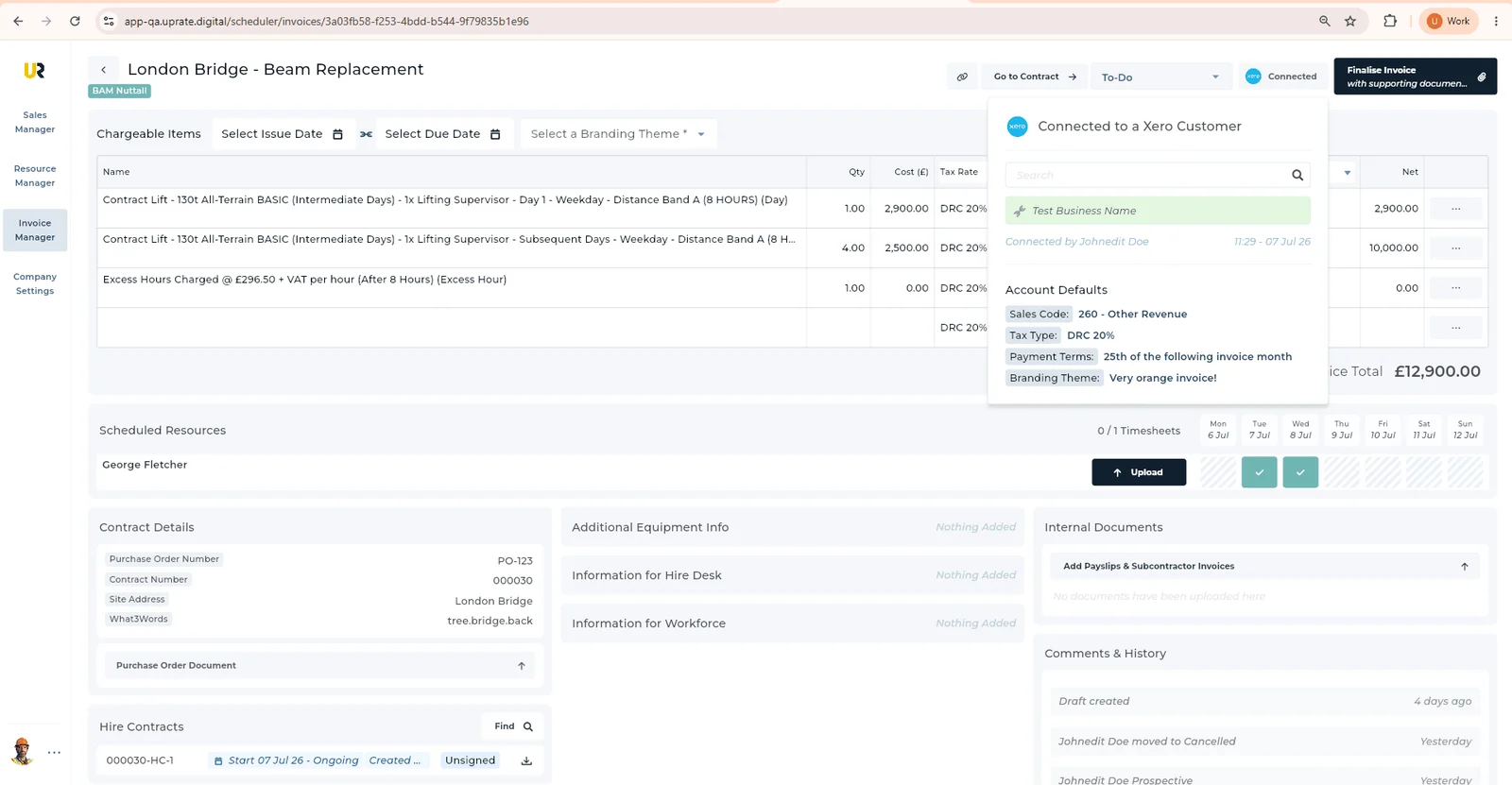
UpRate supports importing charge items from a hire contract into the invoice’s Chargeable Items table. Its documented workflow uses Find to select the hire contract, then Import to bring in the items. Review the result against the completed work before submitting the invoice.
The invoice view also keeps supporting information close to the chargeable items. Use the contract link when you need to check the original agreement, rather than reconstructing it from a separate email chain.
Review the invoice and its Xero connection
Make a final check of the customer, references, chargeable items and invoice details through your normal accounts process. If the job has changed since the contract was prepared, confirm that the final document reflects the agreed work.
UpRate’s documented Xero integration lets you fill out chargeable items, choose a tax rate and sales type, and submit the invoice to Xero. The system then retrieves the invoice PDF from Xero so you can send it to the customer. Check the customer connection and account settings rather than assuming they are correct for every job.
This connects invoice preparation to your accounts workflow, but it does not remove the need to review the source information. Keep a clear handover between the person confirming the work and the person responsible for the invoice.
Keep track of what needs attention next
Sending an invoice is not the end of the job’s administration. Make it clear which records are still waiting for information, which have been invoiced and which need follow-up. Use the status that reflects the actual position rather than treating ‘prepared’, ‘sent’ and ‘paid’ as the same thing.
UpRate’s Invoice Manager uses a Kanban board to organise invoices by status. Keep those records current through your agreed process. Do not assume every payment status updates automatically unless you have verified that behaviour in your setup.
The result to aim for is simple: accounts can find the agreed charges, the completed work and the next action without rebuilding the job. Start with a consistent checklist, then use connected plant-hire invoicing software to keep those records together.
Keep the paperwork with the job.
Start with free Sales Manager for customers and contracts. Compare packages to add the invoicing and scheduling tools you need.
Get Started for FREE Compare packages